
Dual-Head XP600 A3 DTF Printer: How Throughput Changes Your Pricing
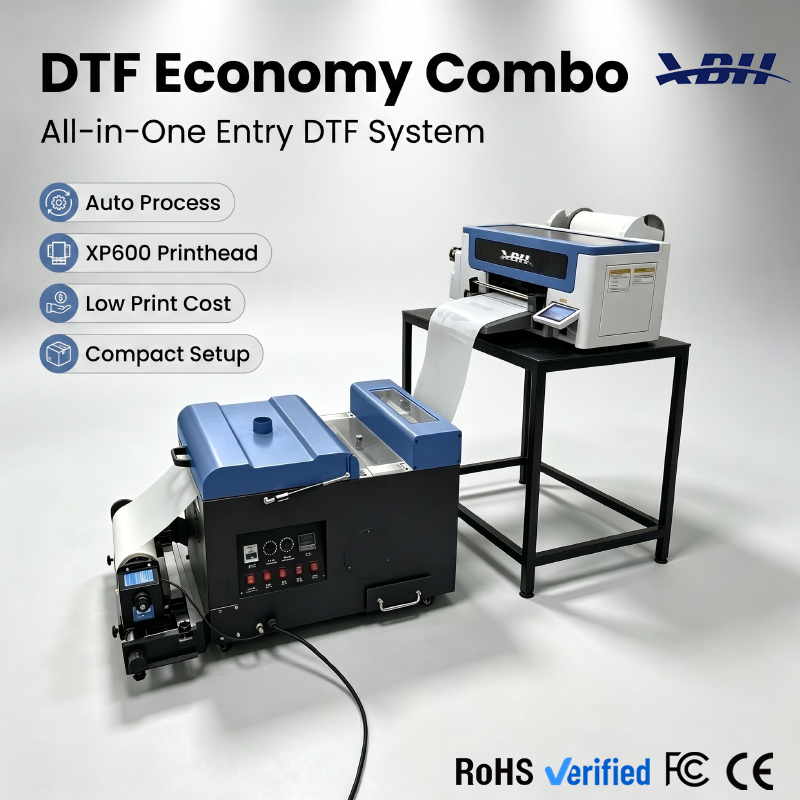
Two shops quoted the same three-hundred-shirt order last month, and the gap between them was not the unit price. One could ship in two working days; the other needed six. The buyer paid more for the faster quote, which is the entire commercial argument for a dual-head XP600 A3 DTF printer.
Throughput is a promise, not a spec sheet line
Apparel buyers are rarely shopping for the cheapest shirt; they are shopping for a date. A team order, a launch or a school event carries a fixed day, and a shop that promises three days instead of seven can price above the market without explaining itself.
That is why the second head matters more than the figure on the brochure. It changes what you can commit to, and commitment is what gets priced.
What the second head actually adds
A dual-head A3 DTF printer with CISS runs two XP600 heads across the same 30 cm width. The practical effect is that a given job finishes in fewer passes, so film leaves the machine sooner and the press queue starts earlier. On multi-colour artwork with heavy white, the difference is most obvious.
CISS is the quieter advantage. Continuous ink supply means fewer interruptions, less ink left in cartridges, and colour density that stays steady through a long run. For a shop that prints every day, uptime is worth more than peak speed.
Working out your honest capacity
Do not price from headline speed. Time a real job end to end: file prep, print, powder, shake, cure, press, cool, fold, pack. Divide by pieces and you have a cost per piece that includes your own hands.
Then apply a realism factor. If a shift is eight hours and you can genuinely print for five of them, plan around five. Quotes built on the other three hours are the ones that run late.
Where the price sits
Industry practice puts DTF margins in the 60–75% range, and shops holding the top of that band usually compete on turnaround rather than on unit price. This configuration lists at $1,358–1,619, so the increment over a single-head line is small relative to what a faster delivery promise is worth across a year.
The habit that follows is simple: quote three tiers. Standard at your normal rate, express at a premium you can actually deliver, and a large-order rate that fills the quiet weeks. The machine gives you room to honour all three.
Keeping two heads healthy
Two heads mean two nozzle checks, and skipping one is how a shop discovers a dead channel mid-order. Print a check pattern every morning, log it, and clean the capping station on a fixed day.
Keep both heads on the same maintenance clock even if one does most of the white work. Ink idling in a channel is the usual source of a dropout at the worst moment.
The limits worth admitting
If orders arrive in ones and twos, the second head will sit idle and the extra maintenance will feel like a tax. This machine earns its place in shops with a steady queue and a promise to keep.
For a walkthrough of film handling and press timing, the articles at https://www.xbh-printer.com/news are a reasonable start. When you are ready to size the machine against your own order book, https://www.xbh-printer.com/contact gets you a straight answer rather than a brochure.