
2.1m Roll-to-Roll Sublimation Flag Machine: Producing Flags That Survive Weather
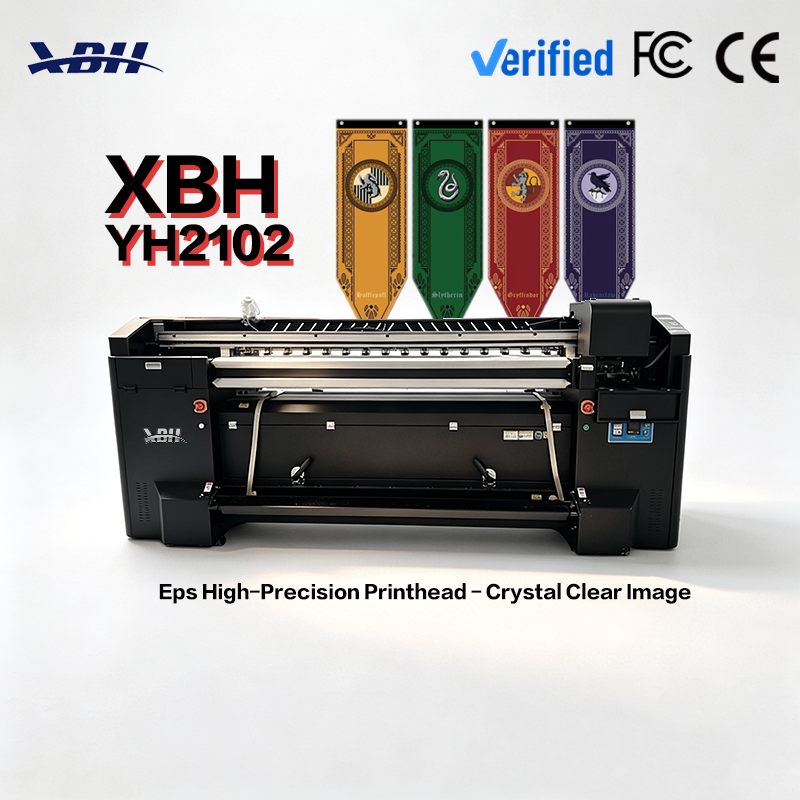
Every February a hotel on the coast orders forty beach flags in the same red. Every July they order again, because the red has gone pink and the white has gone grey. The printer who supplies them treats the repeat as loyalty. It is closer to a complaint that arrives twice a year.
What Kills an Outdoor Flag
Ultraviolet light takes the dye first. Then wind works the hem, and the hem fails before the fabric does. Salt air and rain finish the white areas, which collect airborne dirt because they have nowhere to hide it. A flag that dies at three months usually died at ink load and at the finishing table, not at the print head.
Fabric Sets the Ceiling
Only polyester accepts dye sublimation properly, and not all polyester behaves the same way. A tight warp-knit holds a sharp edge and a clean line. A loose knitted flag fabric prints softer and moves more in wind. A mesh lets air through, which is why it survives gusts that shred a solid panel of the same weight. Choose the cloth before you choose the profile.
Transfer Settings at 2.1m Width
Treat these as starting points, then adjust against your own fabric batch. Dye sublimation is unforgiving of a cold press and of a hot one.
• Flag polyester 110 gsm - 190 C, 45 s, standard ink load
• Warp-knit polyester 150 gsm - 195 C, 55 s, heavier ink for deep blacks
• Mesh polyester 75 gsm - 190 C, 40 s, reduced ink so holes stay open
• Double-sided flag - two printed panels sewn back to back
• Hem - 20 mm double fold, twin needle, UV-stable thread
• Eyelets - brass 12 mm, four corners plus one centre on spans over 1.5 m
Why Width Changes the Process
At 2.1 metres, small errors stop being small. Film loaded slightly off-square drifts across a ten-metre run, and the image walks off the fabric edge before the roll ends. Check tracking at the start of every roll rather than once a week. Heat also varies across a wide platen, with the centre often running hotter than the edges, so a colour that matches in the middle can shift at the border.
Finishing Is Half the Product
A perfect print with a single row of stitching and no reinforcement will fail at the pole before the ink fades. Test the hem by hand: pull it. If the stitch gapes, wind will find that gap in the first storm. Ask the same of any subcontractor you use for sewing.
Planning Around the Season
Flag buyers order on a calendar, not on impulse. Regattas, carnivals, elections, national days and football seasons all have dates fixed months ahead. If you know the six dates your customers care about, you can print in the quiet weeks and hold stock in the common sizes and colours, which is where the margin actually hides.
What the Machine Changes
A roll-to-roll 2.1m machine, priced from 1,589 to 12,899 USD depending on configuration, turns flag work from a series of one-off panels into a continuous run. That matters most for repeat sizes, because the second order costs you film and time rather than setup. The first order pays for the learning curve.
Send us the fabric weights you run and the sizes you sell most, and we will map them against workable settings before you commit to a machine: https://www.xbh-printer.com/contact. Earlier production notes are archived at https://www.xbh-printer.com/news.