PVA Water Transfer Film Rolls: Applications Beyond Clothing
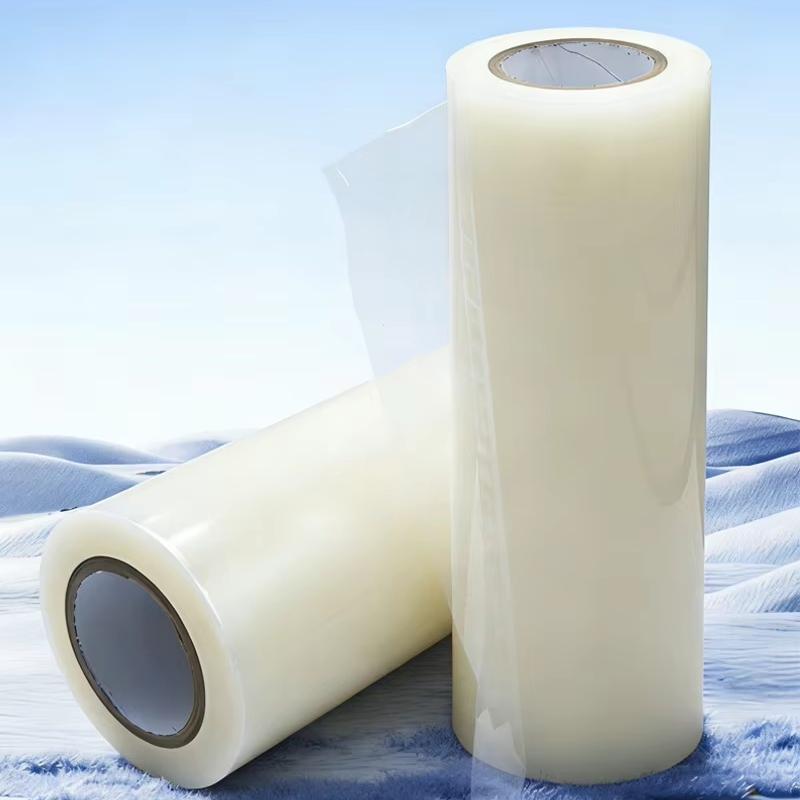
A roll of PVA film stands against the wall of an embroidery workshop, next to the thread rack. It was bought for heat transfers on T-shirts, then sat unused for a season, because the shop's real problem was caps, curved helmet shells and dense stitch blocks that no flat platen could reach. The same roll solved all three.
What the film is, and what it is not
PVA is a water-soluble carrier, not a decorative layer. You print or coat the design onto it, place it on the part, and the film gives up the layer and dissolves, leaving pigment or adhesive behind. Our roll is supplied waterproof in storage, available in custom colours on request, priced from $48 to $79 per roll, with low minimums so a small shop can test first.
Curved and three-dimensional parts
A flat platen cannot follow a bottle shoulder, a helmet shell or a fairing. In a water-transfer setup the film floats on a bath, an activator softens it, and the part is dipped through the floating layer. Thin and stretchable when wet, the film wraps compound curves without the creases a press would leave behind.
Panels a press cannot reach
Caps, cuffs, inner linings, and garments already carrying zips or mesh are awkward under a heat platen. A PVA carrier lets an operator place the transfer by hand, then bond it with a small press or a tunnel. In embroidery, a soluble topper holds down loop pile on caps and terry, rinses out cleanly, and leaves stitch definition without the stiff hand a permanent backing creates.
Wet-transfer labels and craft runs
Away from textiles, the roll works as a sacrificial carrier for short runs of labels on glass, ceramic and coated board, where a pressure-sensitive label would show a visible edge. Soak, slide into position, dry. The graphic ends up flush with the surface instead of sitting on top of it.
Conditions that decide the result
• Bath temperature: 25 to 30 C; below 20 C the film releases slowly and tears at the edges
• Float time: 30 to 45 seconds, until the sheet lies flat with no curl
• Activator: two light passes, 15 seconds apart, no pooling
• Dip angle: 30 to 45 degrees, one continuous motion, never stop mid-part
• Rinse: clean water at 20 to 25 C for 20 to 30 seconds, then air dry
• Cure: 24 hours before washing, packing or stacking
Where it goes wrong
Creases across the pattern mean the film was laid before it relaxed. A milky haze after drying means it was not rinsed enough. Edges lifting a day later usually trace to a contaminated part, and mould release agent on a new shell is the usual culprit. Film that tears in the bath is too cold or too old, since PVA absorbs moisture and loses strength in a humid room.
Who buys by the roll
Promotional suppliers decorating curved drinkware, helmet and accessory painters, embroidery shops needing a soluble topper, and small apparel labels doing runs too short for a cylinder press. They buy rolls rather than metres because one roll covers several quite different jobs.
If you want to test a colour or a thickness against your own bath and your own parts, tell us the substrate and the dip routine at https://www.xbh-printer.com/contact. Application write-ups for other transfer films are archived at https://www.xbh-printer.com/news.