
3D UV DTF A3 Printer: Producing Textured Labels That Stand Out on Shelves
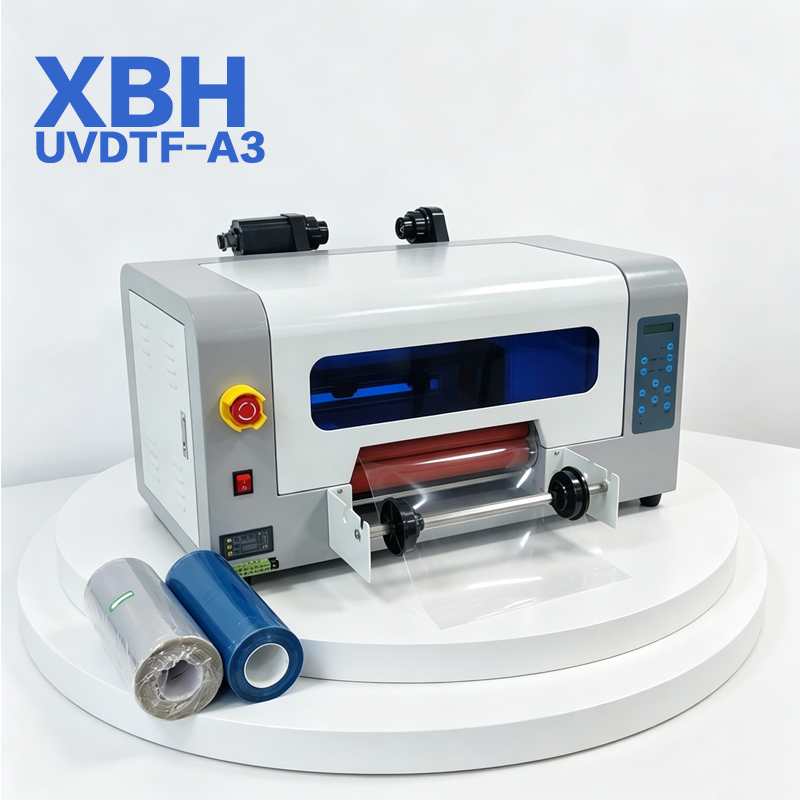
A buyer in Rotterdam sent us a photo last month: two identical gin bottles on one shelf, one wearing a flat printed label, the other a label with a raised, domed logo that caught the store light at a different angle. She asked which machine made the second. That is the whole business case for the 3D UV DTF A3 printer.
Shoppers read texture before they read copy
A label is handled before it is bought. Fingers tilt the bottle, the box, the jar. A flat label answers with colour alone; a raised one answers with colour, gloss and resistance at once, and the difference registers in under a second. Premium drinks and cosmetics move toward domed detail for that reason.
What the 3D effect actually is on this machine
The 3D UV DTF A3 printer uses an XP600 head and prints UV-curable ink onto a roll of transfer film. Colour goes down first, then white, then build-up passes of clear ink that stay raised after curing. The film is laminated, and the patch is applied by hand or with a small applicator.
Height comes from repeat passes, not one thick coat. Two passes give a soft dome; four give a hard, glassy bead that reads across a shop floor.
Running the roll without wasting film
On a roll, job length stops mattering: forty labels and four thousand use the same setup. Group jobs by film type, keep a consistent gap, and print a test patch at the head of every roll.
Cure gets less attention than it needs. Under-cured clear ink stays soft and collects dust; over-cured ink cracks around a curved shoulder. Move in small steps and write down what worked.
A starting recipe list
Clear PET label stock – 1 white, 3 colour, 2 build-up passes
White BOPP, gloss – 2 white, 3 colour, 2 build-up passes
Matte silver PET – 1 white, 3 colour, 1 build-up, slower head speed
Rigid PVC card 0.4 mm – 2 white, 4 colour, 3 build-up passes
Domed logo, 25 mm – 5 build-up passes, tighter inter-pass gap
Treat these as starting points; film batch, room temperature and ink lot all shift the result, so each new roll earns a patch test.
Where the money sits
Industry practice puts UV DTF margins in the 70–85% range on small decorative runs, because substrate cost is small and perceived value is large. Quote by the finished patch, not the metre of film, and keep a sample board of eight to ten textures.
The machine sits in the $480–3,588 band depending on configuration, so payback is rarely the hard part. The harder question is which local products already compete on shelf presence.
Failures that cost the most
Three failures repeat, all operator-side. Film stored in a humid room lifts at the shoulder. Dust under the clear layer shows the instant light hits the dome. A build-up pass printed too fast leaves a ridge that reads as a defect rather than a design.
None need a new head, only a covered film rack, a clean room and a written speed setting. Longer notes on film storage and cure control sit at https://www.xbh-printer.com/news.
Print the same logo at three heights and put samples in front of the buyer; most choose the middle one, which tells you the build-up to standardise on. For a configuration check against your label size and monthly volume, write to https://www.xbh-printer.com/contact.